Approaches to Teaching World Literature
There are 173 products in Approaches to Teaching World Literature
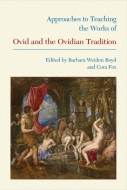
Approaches to Teaching the Works of Ovid and the Ovidian Tradition
Ovid and his influence are studied in classrooms as various as his poetry, and this Approaches volume aims to help instructors in those diverse teaching environments. Part 1, “Materials,” is fittingly collaborative and features brief overviews designed to give nonspecialists background on the more challenging aspects of teaching Ovid. Contributors examine his life and legacy, religion, and relation to the visual arts as well as his afterlife in the Latin classroom, in various translations, and in the Ovide moralisé. The editors detail the contexts in which Ovid is taught, identify trends in teaching his work and the Ovidian tradition, and recommend editions and resources for classroom use.
The introduction to part 2, “Approaches,” considers Ovid’s relation to Vergil and the development of Ovid’s influence and reception, from the medieval and early modern period to the reinvigoration of Ovid studies in the twentieth century. In the four sections that follow, contributors provide practical ideas for classroom instruction, examine the political and moral discourses shaping Ovid and his legacy, explore how gender and the body are represented in Ovid and the Ovidian tradition, and look at various ways Ovid’s works have been used and transformed by writers as diverse as Dante, Cervantes, and Ransmayr.
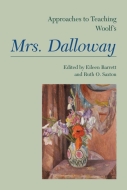
Approaches to Teaching Woolf’s Mrs. Dalloway
Mrs. Dalloway is considered a central work in Virginia Woolf’s oeuvre and in the modernist canon. It not only addresses historical and cultural issues such as war, colonialism, class, politics, marriage, sexuality, and psychology but also reimagines the novel form. Moreover, Mrs. Dalloway continues to grow in its influence and visibility, inspiring adaptations in film, theater, print, and other media.
Despite Mrs. Dalloway’s continued popularity, many students today find the prose daunting and a barrier to their appreciation and comprehension of the novel. This volume seeks to give instructors a variety of strategies for making Woolf’s work compelling and accessible to students while addressing the diverse ways it has been interpreted. Part 1, “Materials,” reviews editions of Mrs. Dalloway as well as critical and historical resources related to the novel. Part 2, “Approaches,” explores the task of contextualizing this key modernist text in the classroom. Some contributors situate Mrs. Dalloway in its historical time and place, namely, London in the period between the two world wars. Others discuss the novel’s narrative form or interpret it using perspectives from cultural studies, feminism, or queer theory. Still others address the novel’s relation to poems, films, and Victorian novels. Finally, a group of essays discusses the challenges and rewards of teaching the novel in settings both traditional and nontraditional, from a college classroom to a prison.
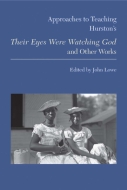
Approaches to Teaching Hurston’s Their Eyes Were Watching God and Other Works
Zora Neale Hurston emerged as a celebrated writer of the Harlem Renaissance, fell into obscurity toward the end of her life, yet is now recognized as a great American author. Her novel Their Eyes Were Watching God is popular among general readers and is widely taught in universities, colleges, and secondary schools. A key text of African American and women’s literature, it has also been studied by scholars interested in the 1930s, small-town life, modernism, folklore, and regionalism, and it has been viewed through the lenses of dialect theory, critical race theory, and transnational and diasporan studies.
Considering the ubiquity of Hurston’s work in the nation’s classrooms, there have been surprisingly few book-length studies of it. This volume helps instructors situate Hurston’s work against the various cultures that engendered it and understand her success as short story writer, playwright, novelist, autobiographer, folklorist, and anthropologist. Part 1 outlines Hurston’s publication history and the reemergence of the author on the literary scene and into public consciousness. Part 2 first concentrates on various approaches to teaching Their Eyes, looking at Hurston’s radical politics and use of folk culture and dialect; contemporary reviews of the novel, including contrary remarks by Richard Wright; Janie’s search for identity in Hurston’s all-black hometown, Eatonville; and the central role of humor in the novel. The essays in part 2 then take up Hurston’s other, rarely taught novels, Jonah’s Gourd Vine, Moses, Man of the Mountain, and Seraph on the Suwanee. Also examined here are Hurston’s anthropological works, chief among them Mules and Men, a staple for many years on American folklore syllabi, and Tell My Horse, newly reconsidered in Caribbean and postcolonial studies.
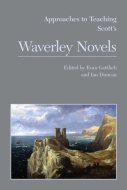
Approaches to Teaching Scott’s Waverley Novels
Scott’s Waverley novels, as his fiction is collectively known, are increasingly popular in the classroom, where they fit into courses that explore topics from Victorianism and nationalism to the rise of the publishing industry and the cult of the author. As the editors of this volume recognize, however, Scott’s fictions present unusual challenges to instructors. Students need guidance, for instance, in navigating Scott’s use of vernacular Scots and antique styles, sorting through his historical and geographical references, and distinguishing his multiple authorial personas. The essays in this volume are designed to help teachers negotiate these and other intriguing features of the Waverley novels. Part 1, “Materials,” guides instructors in selecting appropriate editions of the Waverley novels for classroom use. It also categorizes and lists background and critical studies of Scott’s novels and recommends additional readings for students, as well as multimedia instructional resources.
The essays in part 2 examine the novels’ relation to Scottish history, Scott’s use of language, and concepts of Romantic authorship; consider gender, legal, queer, and multicultural approaches; recommend strategies for teaching Scott alongside other authors such as Jane Austen; and offer detailed ideas for introducing individual novels to students—from imagining Ivanhoe in the context of nineteenth-century medievalism to reconsidering how the ethical issues raised in Old Mortality reflect on religion and violence in our own day.
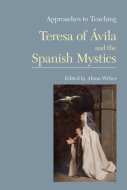
Approaches to Teaching Teresa of Ávila and the Spanish Mystics
The writings of Teresa of Ávila and the Spanish mystics, most notably John of the Cross and Luis de León, aroused passionate responses when they were composed. Though today’s students realize that religious beliefs have wide-ranging consequences, they are presented with particular challenges in studying the Spanish mystics because of their unfamiliarity with the linguistic, social, and religious history of early modern Spain. This volume is designed to help instructors elicit students’ curiosity, sympathy, and appreciation for writings that can at first seem alien or confusing.
Part 1, “Materials,” recommends accessible editions and translations; print, electronic, and visual resources; background and critical studies; and sources on the philosophical and theological responses to the Spanish mystics. Part 2, “Approaches,” presents methods for teaching the historical contexts of and various theoretical perspectives on the mystics’ works. Contributors consider these authors in relation to Islamic and Jewish mysticism, the traditions of women’s writing, feminism, theology, and autobiography. They also recommend ways to teach particular texts in different kinds of courses and institutions.
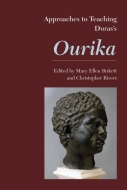
Approaches to Teaching Duras’s Ourika
When it was first published, in 1823, Claire de Duras’s novel Ourika became a best seller almost immediately, and in recent decades, instructors have found it an irresistible addition to their syllabi. But from a teacher’s perspective the novel presents something of a paradox. It is short, its narrative structure is uncomplicated, its vocabulary is limited, its plot is straightforward. It thus lends itself to “simple” readings that fail to reveal the novel’s rich fund of social and historical themes. Set against the backdrop of the French and Haitian revolutions, the Terror, and the restoration and featuring the first black woman narrator in French literature, Ourika raises issues of identity, inequality, exclusion, power, and race and gender relations. The goal of this Approaches volume is to help teachers bring out the novel’s profound and complex underpinnings and reveal Ourika, its Senegalese protagonist, as a victim of history and a timeless tragic heroine.
Part 1 provides an overview of editions of the novel and secondary resources, including critical, historical, and biographical studies. Also featured is a useful time line situating Duras’s life in its historical framework. Part 2 offers a wealth of pedagogical approaches, grouped in four sections, which focus on the historical context of the novel; on race, gender, and class issues; on teaching Ourika with other works of literature; and on interdisciplinary perspectives.
Throughout the volume, the editions of Ourika referred to are the MLA Texts and Translations paperback editions, in French and in English translation, published in 1994.
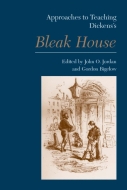
Approaches to Teaching Dickens’s Bleak House
A central text both in Dickens’s career and in the history of the novel itself, Bleak House provides students and teachers occasion to discuss Victorian social concerns involving law, crime, family, education, and money and to learn about every stratum of English society, from the aristocracy to the homeless. But the sheer size of the novel and its narrative intricacy pose pedagogical obstacles. The essays in this volume offer instructors an array of practical strategies for use in the classroom: some describe courses organized exclusively around Bleak House; others offer ideas for teaching a single scene or topic in the novel.
Part 1, “Materials,” assesses editions and provides a guide to the wealth of resources available to instructors, including reference works, critical studies, and background readings, in print and on the Web. The essays in part 2, “Approaches,” discuss nineteenth-century British culture and Victorian social texts; present ways to teach specific scenes, patterns, and problems in the novel; describe intertextual approaches; and detail specific courses taught in different settings and at a variety of educational levels.
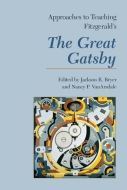
Approaches to Teaching Fitzgerald’s The Great Gatsby
“Who is this Gatsby anyhow?” Answering that question, voiced by one of the book’s characters, is fundamental to teaching F. Scott Fitzgerald’s The Great Gatsby. Although there is no simple answer, classroom analysis of this classic American novel can lead to a rich exploration of the colorful yet contradictory period Fitzgerald dubbed the Jazz Age. The novel also prompts considerations of novelistic technique, specifically point of view, characterization, and narrative structure.
This volume aims to give instructors of The Great Gatsby multiple tools and strategies for teaching the novel and for introducing students to the culture of the 1920s. Part 1, “Materials,” reviews the novel’s composition history and the scholarly resources related to the novel. In part 2, “Approaches,” contributors demonstrate a range of frameworks that usefully inform teaching, from the new historicism to feminist and gender studies to narrative theory. They also examine the novel’s complex artistry, variety of motifs and symbol patterns, and cultural and social influences, such as the era’s changing racial attitudes, the rise of a new suburban culture, and the dichotomy of East versus West in America.
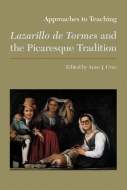
Approaches to Teaching Lazarillo de Tormes and the Picaresque Tradition
In 1554, Lazarillo de Tormes, a slim, unassuming little volume, unsigned by the author, made its first published appearance in the bookstalls of several important mercantile centers in Spain and the Netherlands. Since then, as narratives of pícaros—and pícaras—continued to follow in the footsteps of Lázaro’s fictional life, picaresque literature developed into a major genre in literary studies that remains popular to this day.
Yet the genre’s definition is anything but simple, as the diversity of this volume demonstrates. Part 1, “Materials,” reviews editions and translations of Lazarillo and other picaresque works, as well as the critical and historical resources related to them. The essays in part 2, “Approaches,” explore the picaresque’s place in language and literature classrooms of all levels. Some contributors contextualize Lazarillo in the early modern Spanish culture it satirizes, investigating the role of the church and the marginalization of Muslims and Jews. Others pair Lazarillo with Alemán’s Guzmán de Alfarache or Quevedo’s Buscón to concentrate on the genre’s literary aspects. A cluster of essays focuses on teaching the picaresque (including the female picaresque) to nonspecialist students in interdisciplinary courses. The volume concludes with a section devoted to the picaresque novel’s influence on other literary traditions, from early modern autobiographies, such as Teresa of Ávila’s Libro de la vida, to post–Spanish Civil War texts to twentieth-century Latin American novels and 1950s American beat narratives.
Approaches to Teaching Poe’s Prose and Poetry
Edgar Allan Poe is a popular author, and students have often read his work by the time they reach the college or university classroom. His writings have inspired film, television, and musical adaptations—sources for much of students’ knowledge about Poe. Thus the challenge for teachers is to reacquaint students with Poe as a complex literary figure. This volume equips teachers with the tools necessary to meet that challenge.
Part 1 identifies the most frequently taught Poe texts, reviews useful editions of his work, and suggests secondary sources on Poe as well as television, film, music, and Web materials for use in the classroom. Essays in part 2 explore the relation between Poe’s writing and his biography, including his attitudes toward racial difference and plagiarism and his wide publication in the literary magazines of his time. Contributors consider the range of Poe’s writings, from his horror stories to his analytic essays and tales of ratiocination; his work is also compared with that of Stephen King, Alfred Hitchcock, and graphic novelists. Other essays assess the usefulness of theoretical approaches to Poe, especially psychoanalytic ones, and discuss the controversies concerning the literary merit of his work. Together, these essays bring to life the political, philosophical, and religious context in which Poe wrote.
