Approaches to Teaching World Literature
There are 173 products in Approaches to Teaching World Literature
Approaches to Teaching the Works of Primo Levi
Primo Levi, Holocaust survivor and renowned memoirist, is one of the most widely read writers of post–World War II Italy. His works are characterized by the lean, dispassionate eloquence with which he approaches his experience of incarceration in Auschwitz. His memoirs—as well as his poetry and fiction and his many interviews—are often taught in several fields, including Jewish studies and Holocaust studies, comparative literature, and Italian language and literature, and can enrich the study of history, psychology, and philosophy.
The first part of this volume provides instructors with an overview of the available editions, anthologies, and translations of Levi’s work and identifies other useful classroom aids, such as films, music, and online resources. In the second part, contributors describe different approaches to teaching Levi’s work. Some, in presenting Survival in Auschwitz, The Reawakening, and The Drowned and the Saved, look at the place of style in Holocaust testimony and the reliability of memory in autobiography. Others focus on questions of translation, complicated by the untranslatable in the language and experiences of the concentration camps, or on how Levi incorporates his background as a chemist into his writing, most clearly in The Periodic Table.
Approaches to Teaching Austen’s Mansfield Park
There were no reviews of Mansfield Park when it first appeared in 1814. Austen’s reputation grew in the Victorian period, but it was only in the twentieth century that formal and sustained criticism began of this work, which, more than Austen’s earlier novels, addresses the context and controversies of its time. Lionel Trilling praised Mansfield Park for exploring the difficult moral life of modernity; Edward Said brought postcolonial theory to the study of the novel; and twenty-first-century critics scrutinize these and other approaches to build on and go beyond them.
This volume is the third in the MLA Approaches series to deal with Austen’s work (Pride and Prejudice and Emma were the subject of the first and second volumes on Austen, respectively). It provides information about editions, film adaptations, and digital resources, and then nineteen essays discuss various aspects of Mansfield Park, including the slave trade, the theme of reading, elements of tragedy, gift theory, landscape design, moral improvement in the spirit of Samuel Johnson and of the Reformation, sibling relations, card playing, and interpretations of Fanny Price, the heroine, not as passive but as having some control.
Approaches to Teaching Petrarch’s Canzoniere and the Petrarchan Tradition
One of the most important authors of the Middle Ages, Petrarch occupies a complex position: historically, he is a medieval author, but, philosophically, he heralds humanism and the Renaissance. Teachers of Petrarch’s Canzoniere and his formative influence on the canon of Western European poetry face particular challenges. Petrarch’s poetic style brings together the classical tradition, Christianity, an exalted sense of poetic vocation, and an obsessive love for Laura during her life and after her death in ways that can seem at once very strange and—because of his style’s immense influence—very familiar to students. This volume aims to meet the varied needs of instructors, whether they teach Petrarch in Italian or in translation, in surveys or in specialized courses, by providing a wealth of pedagogical approaches to Petrarch and his legacy.
Part 1, “Materials,” reviews the extensive bibliography on Petrarch and Petrarchism, covering editions and translations of the Canzoniere, secondary works, and music and other audiovisual and electronic resources. Part 2, “Approaches,” opens with essays on teaching the Canzoniere and continues with essays on teaching the Petrarchan tradition. Some contributors use the design and structure of the Canzoniere as entryways into the work; others approach it through discussion of Petrarch’s literary influences and subject matter or through the context of medieval Christianity and culture. The essays on Petrarchism map the poet’s influence on the Italian lyric tradition as well as on other national literatures, including Spanish, French, English, and Russian.
Approaches to Teaching Chaucer’s Canterbury Tales
Chaucer’s Canterbury Tales was the subject of the first volume in the Approaches to Teaching series, published in 1980. But in the past thirty years, Chaucer scholarship has evolved dramatically, teaching styles have changed, and new technologies have created extraordinary opportunities for studying Chaucer. This second edition of Approaches to Teaching Chaucer’s Canterbury Tales reflects the wide variety of contexts in which students encounter the poem and the diversity of perspectives and methods instructors bring to it. Perennial topics such as class, medieval marriage, genre, and tale order rub shoulders with considerations of violence, postcoloniality, masculinities, race, and food in the tales.
The first section, “Materials,” reviews available editions, scholarship, and audiovisual and electronic resources for studying The Canterbury Tales. In the second section, “Approaches,” thirty-six essays discuss strategies for teaching Chaucer’s language, for introducing theory in the classroom, for focusing on individual tales, and for using digital resources in the classroom. The multiplicity of approaches reflects the richness of Chaucer’s work and the continuing excitement of each new generation’s encounter with it.
Approaches to Teaching Coetzee’s Disgrace and Other Works
The novels of the South African writer J. M. Coetzee won him global recognition and the Nobel Prize in Literature in 2003. His work offers substantial pedagogical richness and challenges. Coetzee treats such themes as race, aging, gender, animal rights, power, violence, colonial history and accountability, the silent or silenced other, sympathy, and forgiveness in an allusive and detached prose that avoids obvious answers or easy ethical reassurance.
Part 1 of this volume, “Materials,” identifies secondary materials, including multimedia and Internet resources, that will help instructors guide their students through the contextual and formal complexities of Coetzee’s fiction. In part 2, “Approaches,” essays discuss how to teach works that are sometimes suspicious of teachers and teaching. The essays aim to help instructors negotiate Coetzee’s ironies and allegories in his treatment of human relationships in a changing South Africa and of the shifting connections between human beings and the biosphere.
Approaches to Teaching Behn’s Oroonoko
Once merely a footnote in Restoration and eighteenth-century studies and rarely taught, Oroonoko; or, The Royal Slave (1688), by Aphra Behn, is now essential reading for scholars and a classroom favorite. It appears in general surveys and in courses on early modern British writers, postcolonial literature, American literature, women’s literature, drama, the slave narrative, and autobiography.
Part 1 of this volume, “Materials,” provides not only resources for the teacher of Oroonoko but also a brief chronology of Behn’s life and work. In part 2, “Approaches,” essays offer a diversity of perspectives appropriate to a text that challenges student assumptions and contains not one story but many: Oroonoko as a romance, as a travel account, as a heroic tragedy, as a window to seventeenth-century representations of race, as a reflection of Tory-Whig conflict in the time of Charles II.
Approaches to Teaching Shakespeare’s The Taming of the Shrew
The impetus for this Approaches to Teaching volume on The Taming of the Shrew grew from the editors’ desire to discover why a play notorious for its controversial exploration of conflicts between men and women and the challenges of marriage is enduringly popular in the classroom, in the performing arts, and in scholarship. The result is a volume that offers practical advice to teachers on editions and teaching resources in part 1, “Materials,” while illuminating how the play’s subtle and complex arguments regarding not just marriage but a host of other subjects—modes of early modern education, the uses of clever rhetoric, intergenerational and class politics, the power of theater—are being brought to life in college classrooms. The essays in part 2, “Approaches,” are written by English and theater instructors who have taught in a variety of academic settings and cover topics including early modern homilies and music, Hollywood versions of The Taming of the Shrew, and student performances.
Approaches to Teaching the Works of John Dryden
Which John Dryden should be brought into the twenty-first-century college classroom? The rehabilitator of the ancients? The first of the moderns? The ambivalent laureate? The sidelined convert to Rome? The literary theorist? The translator? The playwright? The poet? This volume in the MLA series Approaches to Teaching World Literature addresses the tensions, contradictions, and versatility of a writer who, in the words of Samuel Johnson, “found [English poetry] brick, and left it marble,” who was, in the words of Walter Scott, “one of the greatest of our masters.”
Part 1, “Materials,” offers a guide to the teaching editions of Dryden’s work and a discussion of the background resources, from biographies and literary criticism to social, cultural, political, and art histories. In part 2, “Approaches,” essays describe different pedagogical entries into Dryden and his time. These approaches cover subjects as various as genre, adaptation, literary rivalry, musical setting, and political and religious poetry in classroom situations that range from the traditional survey to learning through performance.
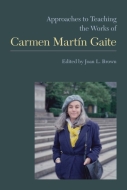
Approaches to Teaching the Works of Carmen Martín Gaite
The career of Spain’s celebrated author Carmen Martín Gaite spanned the Spanish Civil War, Franco’s dictatorship, and the nation’s transition to democracy. She wrote fiction, poetry, drama, screenplays for television and film, and books of literary and cultural analysis. The only person to win Spain’s National Prize for Literature (Premio Nacional de las Letras) twice, Martín Gaite explored and blended a range of genres, from social realism to the fantastic, as she took up issues of gender, class, economics, and aesthetics in a time of political upheaval.
Part 1 (“Materials”) of this volume provides resources for instructors and a literary-historical chronology. The essays in part 2 (“Approaches”) consider Martín Gaite’s best-known novel, The Back Room (El cuarto de atrás), and other works from various perspectives: narratological, feminist, sociocultural, stylistic. In an appendix, the volume editor, who was a friend of the author, provides a new translation of Martín Gaite’s only autobiographical sketch, alongside the original Spanish.
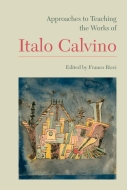
Approaches to Teaching the Works of Italo Calvino
Italo Calvino, whose works reflect the major literary and cultural trends of the second half of the twentieth century, is known for his imagination, humor, and technical virtuosity. He explores topics such as neorealism, folktale, fantasy, and social and political allegory and experiments with narrative style and structure. Students take delight in Calvino’s wide-ranging and inventive work, whether in Italian courses or in courses in comparative or world literature, literary criticism, cultural studies, philosophy, or even architecture.
Given the range of his writing, teaching Calvino can seem a daunting task. This volume aims to help instructors develop creative and engaging classroom strategies. Part 1, “Materials,” presents an overview of Calvino’s writings, nearly all of which are available in English translation, as well as critical works and online resources. The essays in part 2, “Approaches,” focus on general themes and cultural contexts, address theoretical issues, and provide practical classroom applications. Contributors describe strategies for teaching Calvino that are as varied as his writings, whether having students study narrative theory through If on a winter’s night a traveler, explore literary genre with Cosmicomics, improve their writing using Six Memos for the Next Millennium, or read Mr. Palomar in a general education humanities course.
