Approaches to Teaching World Literature
There are 173 products in Approaches to Teaching World Literature
Approaches to Teaching the Works of Primo Levi
Primo Levi, Holocaust survivor and renowned memoirist, is one of the most widely read writers of post–World War II Italy. His works are characterized by the lean, dispassionate eloquence with which he approaches his experience of incarceration in Auschwitz. His memoirs—as well as his poetry and fiction and his many interviews—are often taught in several fields, including Jewish studies and Holocaust studies, comparative literature, and Italian language and literature, and can enrich the study of history, psychology, and philosophy.
The first part of this volume provides instructors with an overview of the available editions, anthologies, and translations of Levi’s work and identifies other useful classroom aids, such as films, music, and online resources. In the second part, contributors describe different approaches to teaching Levi’s work. Some, in presenting Survival in Auschwitz, The Reawakening, and The Drowned and the Saved, look at the place of style in Holocaust testimony and the reliability of memory in autobiography. Others focus on questions of translation, complicated by the untranslatable in the language and experiences of the concentration camps, or on how Levi incorporates his background as a chemist into his writing, most clearly in The Periodic Table.
Approaches to Teaching the Works of Jack London
A prolific and enduringly popular author—and an icon of American fiction—Jack London is a rewarding choice for inclusion in classrooms from middle school to graduate programs. London’s biography and the role played by celebrity have garnered considerable attention, but the breadth of his personal experiences and political views and the many historical and cultural contexts that shaped his work are key to gaining a nuanced view of London’s corpus of works, as this volume’s wide-ranging perspectives and examples attest.The first section of this volume, “Materials,” surveys the many resources available for teaching London, including editions of his works, sources for his photography, and audiovisual aids. In part 2, “Approaches,” contributors recommend practices for teaching London’s works through the lenses of socialism and class, race, gender, ecocriticism and animal studies, theories of evolution, legal theory, and regional history, both in frequently taught texts such as The Call of the Wild, “To Build a Fire,” and Martin Eden and in his lesser-known works.
Approaches to Teaching the Works of Naguib Mahfouz
Naguib Mahfouz is the Arab world’s best-known writer and the single most important chronicler and analyst of twentieth-century Egypt. He was awarded the Nobel Prize in Literature in 1988, and since then his work has been increasingly studied in North American university classrooms. This first volume in the MLA series Approaches to Teaching World Literature to focus on an Arab author or Arabic literature provides an introduction to Mahfouz.
In part 1, “Materials,” the editors discuss Mahfouz’s background, influence, and critical reception. In part 2, “Approaches,” the volume’s contributors offer information, resources, and insights for teaching his work. Topics covered include the Arabian Nights tradition in Mahfouz’s work, the challenge of teaching Mahfouz in English translation, the Nasserite intellectual in The Beggar, the image of Alexandria in Miramar, the bitterness of British occupation in Midaq Alley, and the quest of Sufism in “Zaabalawi.”
Approaches to Teaching Mann’s Death in Venice and Other Short Fiction
Widely taught in undergraduate and graduate courses, the works of Thomas Mann, the 1929 Nobel Prize laureate for literature, continue to fascinate readers. This collection of essays for teachers focuses primarily on Death in Venice, Tonio Kröger, and Tristan, which, on the basis of responses to an international survey conducted to prepare this volume, are Mann’s most frequently taught works of short fiction.
Like other books in the MLA’s Approaches to Teaching World Literature series, this one is divided into two parts. The first part, “Materials,” is a comprehensive overview of instruction resources: editions and translations, reference works, background materials, general introductions and critical studies, and audiovisual materials. In the second part, “Approaches,” fourteen scholars provide illuminating descriptions of effective ways to teach Mann’s work, whether in translation or in the original German. Essays discuss the literary importance of Death in Venice, Tonio Kröger, and Tristan and examine Mann’s fiction from historical, cultural, psychoanalytic, feminist, and philosophical viewpoints.
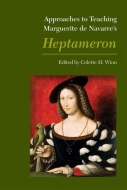
Approaches to Teaching Marguerite de Navarre’s Heptameron
Marguerite de Navarre—writer, reformer, patron—was a key figure of the French Renaissance. Her works, however, were critically reassessed by scholars only in the twentieth century. Today her Heptameron is widely anthologized and frequently taught in undergraduate and graduate classrooms. But teaching this collection of novellas presents challenges: the work is in Middle French, complex in its construction, and far-reaching in its use of historical context. This ninety-fifth volume in the Approaches to Teaching World Literature series aims to show teachers how to unravel the intricacies of the Heptameron for students. The first part, “Materials,” reviews editions and translations, surveys sources that are useful in the classroom, and considers audiovisual and technological resources available to instructors. The second part, “Approaches,” features twenty-seven essays that explore the Heptameron and its cultural and historical contexts; the religious and political ideas and the literary genres that influenced it; its publishing history; and its relation to other works by Marguerite. Experienced instructors share insights about how to teach this work in foreign language and survey courses; how to incorporate film and visual art in the classroom; and how to approach the subject of gender in discussing Marguerite’s writing.
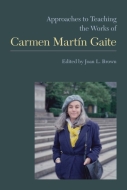
Approaches to Teaching the Works of Carmen Martín Gaite
The career of Spain’s celebrated author Carmen Martín Gaite spanned the Spanish Civil War, Franco’s dictatorship, and the nation’s transition to democracy. She wrote fiction, poetry, drama, screenplays for television and film, and books of literary and cultural analysis. The only person to win Spain’s National Prize for Literature (Premio Nacional de las Letras) twice, Martín Gaite explored and blended a range of genres, from social realism to the fantastic, as she took up issues of gender, class, economics, and aesthetics in a time of political upheaval.
Part 1 (“Materials”) of this volume provides resources for instructors and a literary-historical chronology. The essays in part 2 (“Approaches”) consider Martín Gaite’s best-known novel, The Back Room (El cuarto de atrás), and other works from various perspectives: narratological, feminist, sociocultural, stylistic. In an appendix, the volume editor, who was a friend of the author, provides a new translation of Martín Gaite’s only autobiographical sketch, alongside the original Spanish.
Approaches to Teaching the Works of Cormac McCarthy
In the decades since his 1992 breakout novel, All the Pretty Horses, Cormac McCarthy has gained a reputation as one of the greatest contemporary American authors. Experimenting with genres such as the crime thriller, the post-apocalyptic novel, and the western, his work also engages with the aesthetics of cinema, and several of his novels have been adapted for the screen. While timely and relevant, his works use idiosyncratic language and contain intense, troubling portrayals of racism, sexism, and violence that can pose challenges for students.
This volume offers strategies for guiding students through McCarthy’s oeuvre, addressing all his novels as well as his published plays and screenplays. Part 1, “Materials,” provides sources of biographical information and key scholarship on McCarthy. Essays in part 2, “Approaches,” discuss subjects such as landscape and ecology, mythologies of the American West, film adaptations, and literary contexts and describe assignments that encourage students to write creatively and to examine their personal values.
Approaches to Teaching Medieval English Drama
Anyone who has recently attended a professional meeting devoted to medieval drama or witnessed a revival of a medieval play knows that the genre is alive and flourishing. This volume offers help for new teachers of these works, encourages experienced teachers to rethink classroom presentation of familiar plays, and suggests new ways for all teachers to integrate medieval drama into undergraduate courses.
Like other books in the Approaches series, this one is divided into two parts. The first part, “Materials,” reviews editions, translations, and anthologies of medieval drama and discusses useful secondary readings for both students and instructors. In the second part, “Approaches,” seventeen essays present a rich array of ideas for teaching medieval English drama, from the liturgical texts of the tenth century to the morality plays and cycle plays of the fifteenth century. Several authors focus on particular classroom strategies; others apply methodologies informed by theoretical approaches such as feminism, semiotics, and anthropology; still others discuss staging and performance of the plays.
Approaches to Teaching Melville’s Moby-Dick
Pondering the physical and metaphysical implications of the whale’s circulatory system, the narrator of Moby-Dick says, “But how easy and how hopeless to teach these fine things!” Ishmael’s exclamation is reflected in the two purposes of this volume: to provide a practical “starter kit,” particularly for instructors who are teaching the novel for the first time, and to stimulate the resourcefulness and creativity of all teachers—including those who have taught the novel for years. The many suggestions and approaches in this collection are distilled in large part from the responses to a lengthy survey of 139 teachers and 72 students.
This volume, like others in the MLA’s Approaches to Teaching World Literature series, is divided into two parts. The first part, “Materials,” reviews editions, critical and background reading, reference works, and aids to teaching (including audiovisual materials). In the second part, “Approaches,” fourteen teachers share strategies for presenting Moby-Dick to a range of college audiences, from members of a freshman honors course to non-English majors. The contributors consider basic questions on how to teach the novel (e.g., whether to teach the book while students are reading it or after they have finished; what types of background materials to present) and employ a spectrum of methodologies and techniques (e.g., encouraging students to keep journals; exploring the novel’s lexicon; incorporating the paintings of J. M. W. Turner).
Approaches to Teaching the Metaphysical Poets
Using the now controversial designation metaphysical as a term to be debated or dissected, this book helps teachers with the classroom process of discriminating among the metaphysical and other poems of five important seventeenth-century poets: John Donne, George Herbert, Henry Vaughan, Richard Crashaw, and Andrew Marvell.
The volume, like others in the MLA’s Approaches to Teaching World Literature series, is divided into two parts. The first part, “Materials,” reviews editions of the poems, anthologies, recommended readings for students, aids to teaching, reference works, and background studies. The second part, “Approaches,” presents essays by eighteen teachers in three sections. The first section deals with general discussions and backgrounds, addressing such important topics as seventeenth-century love poetry, religion, iconography, and representations of women in metaphysical poetry. Another group of essays explores various course contexts, including lower- and upper-division survey courses and a humanities-based composition course. The final section presents essays focusing on each of the five poets.
