Approaches to Teaching World Literature
There are 173 products in Approaches to Teaching World Literature
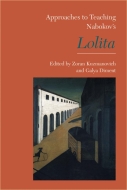
Approaches to Teaching Nabokov’s Lolita
Widely considered one of the twentieth century’s great novels, Lolita maintains an established place on the syllabus—in English departments, Russian and Slavic departments, and departments of comparative literature. Yet its particular mix of narrative strategies, ornate allusive prose, and troublesome subject matter complicates its presentation to students.
This volume aims to help instructors make Lolita accessible to students. Part 1, “Materials,” opens with an extensive chronology of the author’s life, outlines the novel’s convoluted publication history, and identifies useful textual and audiovisual resources for teaching Lolita. In part 2, “Approaches,” instructors reflect on the best ways to illuminate the novel’s ethical quandries and introduce its textual intricacies. The twenty-two essays are grouped by three themes: instructors’ experiences teaching Lolita in specific courses; the literary, generic, and cultural contexts of the novel, including its Russian roots, Romantic tropes and themes, and representation of 1950s American culture; and the theoretical approaches to the novel, which address ethics and aesthetics, the role of readers, and the connection between the author and the narrator.
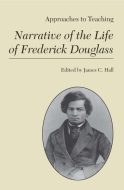
Approaches to Teaching Narrative of the Life of Frederick Douglass
One of the most frequently taught slave narratives, Narrative of the Life of Frederick Douglass is assigned in many courses, including American and African American literature, African American studies, women’s studies, and even composition. Regularly excerpted in introductory American literature and composition anthologies, Douglass’s classic first-person account is ideal for exploring the artistic accomplishment of the slave narrator. In this Approaches to Teaching World Literature volume, sixteen essays on teaching the work testify to the complexity of such accounts and their possibilities in the classroom.
Like other books in the MLA’s Approaches series, this one is divided into two parts. The first part, “Materials,” discusses the reference works, historical and critical studies, and other materials most commonly used and recommended by teachers of Douglass’s work. In the second part, “Approaches,” a diverse group of scholars describe methods of presentation that they have found effective for enlivening classroom discussion and enhancing students’ appreciation of the text. Their essays outline the challenges posed by Narrative of the Life of Frederick Douglass and the fundamental literary and historical debates surrounding the narrator’s account. They also evaluate problems of cultural authority and historical record, provide examples of teaching the text alongside other slave narratives, and suggest ways to incorporate it into introductory courses such as humanities and world literature.
Approaches to Teaching the Works of Tim O’Brien
“The works of Tim O’Brien are among the most significant recent contributions to a lengthy canon of war literature,” write the editors of this volume; they serve “as an ideal point of entry for discussions of war and its human impact.” The author of the highly acclaimed The Things They Carried, O’Brien is a Pulitzer Prize finalist and the winner of a National Book Award for Going After Cacciato.
This volume in the Approaches to Teaching series considers the range and depth of O’Brien’s writing, with an emphasis on works that focus on the Vietnam War. Part 1, “Materials,” provides information on O’Brien’s life and an overview of his literary output. It also directs readers to critical and reference works on subjects encountered in his writing. The twenty-three essays in part 2, “Approaches,” provide historical background on the Vietnam War; explore narrative issues in O’Brien’s works, such as the melding of fiction, nonfiction, and memoir; and suggest ideas for teaching the author’s works in a variety of classroom and conceptual settings (e.g., composition, American literature, war fiction, narrative theory, postmodernism).
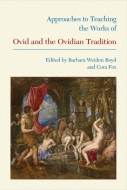
Approaches to Teaching the Works of Ovid and the Ovidian Tradition
Ovid and his influence are studied in classrooms as various as his poetry, and this Approaches volume aims to help instructors in those diverse teaching environments. Part 1, “Materials,” is fittingly collaborative and features brief overviews designed to give nonspecialists background on the more challenging aspects of teaching Ovid. Contributors examine his life and legacy, religion, and relation to the visual arts as well as his afterlife in the Latin classroom, in various translations, and in the Ovide moralisé. The editors detail the contexts in which Ovid is taught, identify trends in teaching his work and the Ovidian tradition, and recommend editions and resources for classroom use.
The introduction to part 2, “Approaches,” considers Ovid’s relation to Vergil and the development of Ovid’s influence and reception, from the medieval and early modern period to the reinvigoration of Ovid studies in the twentieth century. In the four sections that follow, contributors provide practical ideas for classroom instruction, examine the political and moral discourses shaping Ovid and his legacy, explore how gender and the body are represented in Ovid and the Ovidian tradition, and look at various ways Ovid’s works have been used and transformed by writers as diverse as Dante, Cervantes, and Ransmayr.
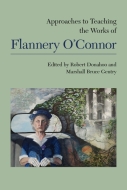
Approaches to Teaching the Works of Flannery O’Connor
Known for her violent, startling stories that culminate in moments of grace, Flannery O’Connor depicted the postwar segregated South from a unique perspective. This volume proposes strategies for introducing students to her Roman Catholic aesthetic, which draws on concepts such as incarnation and original sin, and offers alternative contexts for reading her work.
Part 1, “Materials,” describes resources that provide a grounding in O’Connor’s work and life. The essays in part 2, “Approaches,” discuss her beliefs about writing and her distinctive approach to fiction and religion; introduce fresh perspectives, including those of race, class, gender, and interdisciplinary approaches; highlight her craft as a creative writer; and suggest pairings of her works with other texts. Alice Walker’s short story “Convergence” is included as an appendix.
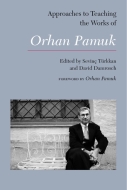
Approaches to Teaching the Works of Orhan Pamuk
Winner of the Nobel Prize in Literature in 2006, Orhan Pamuk is Turkey’s preeminent novelist and an internationally recognized figure of letters. Influenced by both Turkish and European literature, his works interrogate problems of modernity and of East and West in the Turkish context and incorporate the Ottoman legacy linguistically and thematically. The stylistic and thematic aspects of his novels, his intriguing use of intertextual elements, and his characters’ metatextual commentaries make his work rewarding in courses on world literature and on the postmodern novel. Pamuk’s nonfiction writings extend his themes of memory, loss, personal and political histories, and the craft of the novel.
Part 1, “Materials,” provides biographical background and introduces instructors to translations and critical scholarship that will elucidate Pamuk’s works. In part 2, “Approaches,” essays cover topics that support teachers in a range of classrooms, including Pamuk’s use of the Turkish language, the political background to Pamuk’s novels, the politics of translation and aesthetics, and Pamuk’s works as world literature.
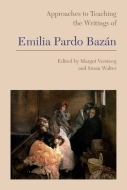
Approaches to Teaching the Writings of Emilia Pardo Bazán
“Emilia Pardo Bazán (1851–1921) was the most prolific and influential woman writer of late nineteenth-century Spain,” write the editors of this volume in the MLA’s Approaches to Teaching World Literature series. Her writings—novels, novellas, short stories, essays, plays, travel writing, and cookbooks—cover topics from fashion to science and technology to gender equality. In a literary style characterized by brilliance, they contend with the critical issues of her time and are compelling to teach today.
Part 1, “Materials,” provides biographical and critical resources, an overview of Pardo Bazán’s vast oeuvre, and a literary-historical time line. It also reviews secondary sources, editions and translations, and digital resources. The essays in part 2, “Approaches,” explore Pardo Bazán’s engagement with contemporary literary movements, feminism and gender, nation and the late Spanish empire, Spanish and Galician identities, and nineteenth-century scientific and medical discourses. Film adaptations and translations of Pardo Bazán’s works are also addressed. Instructors of courses on world literature, nineteenth-century literature, gender studies, and Spanish-language courses will find the volume invaluable.
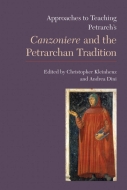
Approaches to Teaching Petrarch’s Canzoniere and the Petrarchan Tradition
One of the most important authors of the Middle Ages, Petrarch occupies a complex position: historically, he is a medieval author, but, philosophically, he heralds humanism and the Renaissance. Teachers of Petrarch’s Canzoniere and his formative influence on the canon of Western European poetry face particular challenges. Petrarch’s poetic style brings together the classical tradition, Christianity, an exalted sense of poetic vocation, and an obsessive love for Laura during her life and after her death in ways that can seem at once very strange and—because of his style’s immense influence—very familiar to students. This volume aims to meet the varied needs of instructors, whether they teach Petrarch in Italian or in translation, in surveys or in specialized courses, by providing a wealth of pedagogical approaches to Petrarch and his legacy.
Part 1, “Materials,” reviews the extensive bibliography on Petrarch and Petrarchism, covering editions and translations of the Canzoniere, secondary works, and music and other audiovisual and electronic resources. Part 2, “Approaches,” opens with essays on teaching the Canzoniere and continues with essays on teaching the Petrarchan tradition. Some contributors use the design and structure of the Canzoniere as entryways into the work; others approach it through discussion of Petrarch’s literary influences and subject matter or through the context of medieval Christianity and culture. The essays on Petrarchism map the poet’s influence on the Italian lyric tradition as well as on other national literatures, including Spanish, French, English, and Russian.
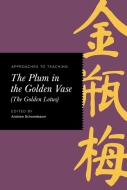
Approaches to Teaching The Plum in the Golden Vase (The Golden Lotus)
The Plum in the Golden Vase (also known as The Golden Lotus) was published in the early seventeenth century and may be the first long work of Chinese fiction written by a single (though anonymous) author. Featuring both complex structural elements and psychological and emotional realism, the novel centers on the rich merchant Ximen Qing and his household and describes the physical surroundings and material objects of a Ming dynasty city. In part a social, political, and moral critique, the novel reflects on hierarchical power relations of family and state and the materialism of life at the time.
The essays in this volume provide ideas for teaching the novel using a variety of approaches, from questions of genre, intertextuality, and the novel's reception to material culture, family and social dynamics, and power structures in sexual relations. Insights into the novel's representation of Buddhism, Chinese folk religion, legal culture, class, slavery, and obscenity are offered throughout the volume.
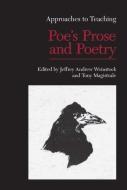
Approaches to Teaching Poe’s Prose and Poetry
Edgar Allan Poe is a popular author, and students have often read his work by the time they reach the college or university classroom. His writings have inspired film, television, and musical adaptations—sources for much of students’ knowledge about Poe. Thus the challenge for teachers is to reacquaint students with Poe as a complex literary figure. This volume equips teachers with the tools necessary to meet that challenge.
Part 1 identifies the most frequently taught Poe texts, reviews useful editions of his work, and suggests secondary sources on Poe as well as television, film, music, and Web materials for use in the classroom. Essays in part 2 explore the relation between Poe’s writing and his biography, including his attitudes toward racial difference and plagiarism and his wide publication in the literary magazines of his time. Contributors consider the range of Poe’s writings, from his horror stories to his analytic essays and tales of ratiocination; his work is also compared with that of Stephen King, Alfred Hitchcock, and graphic novelists. Other essays assess the usefulness of theoretical approaches to Poe, especially psychoanalytic ones, and discuss the controversies concerning the literary merit of his work. Together, these essays bring to life the political, philosophical, and religious context in which Poe wrote.
