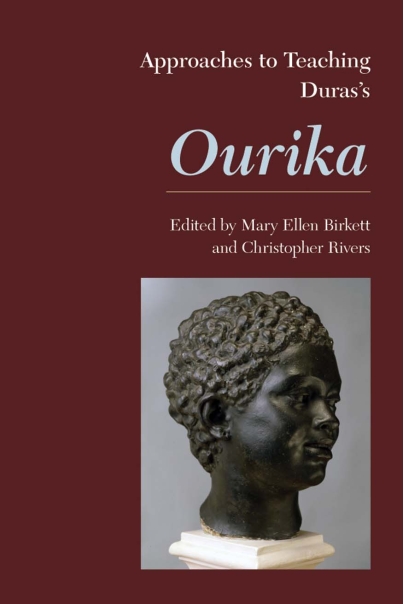
Approaches to Teaching Duras’s Ourika
- Editors: Mary Ellen Birkett, Christopher Rivers
- Pages: vii & 184 pp.
- Published: 2009
- ISBN: 9781603290197 (Paperback)
- ISBN: 9781603290180 (Hardcover)

“As a professor of French who has taught Ourika in upper-division French courses countless times, I find that this volume has greatly enhanced my own teaching as well as the scholarly lens through which I read this novel.”
—Nineteenth-Century French Studies
When it was first published, in 1823, Claire de Duras’s novel Ourika became a best seller almost immediately, and in recent decades, instructors have found it an irresistible addition to their syllabi. But from a teacher’s perspective the novel presents something of a paradox. It is short, its narrative structure is uncomplicated, its vocabulary is limited, its plot is straightforward. It thus lends itself to “simple” readings that fail to reveal the novel’s rich fund of social and historical themes. Set against the backdrop of the French and Haitian revolutions, the Terror, and the restoration and featuring the first black woman narrator in French literature, Ourika raises issues of identity, inequality, exclusion, power, and race and gender relations. The goal of this Approaches volume is to help teachers bring out the novel’s profound and complex underpinnings and reveal Ourika, its Senegalese protagonist, as a victim of history and a timeless tragic heroine.
Part 1 provides an overview of editions of the novel and secondary resources, including critical, historical, and biographical studies. Also featured is a useful time line situating Duras’s life in its historical framework. Part 2 offers a wealth of pedagogical approaches, grouped in four sections, which focus on the historical context of the novel; on race, gender, and class issues; on teaching Ourika with other works of literature; and on interdisciplinary perspectives.
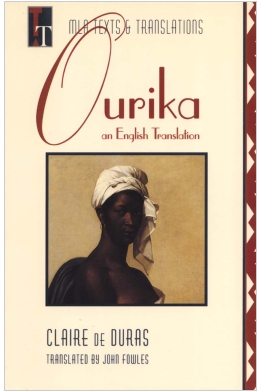
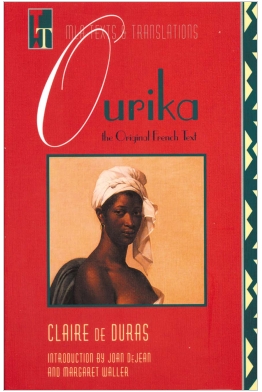
Throughout the volume, the editions of Ourika referred to are the MLA Texts and Translations paperback editions, in French and in English translation, published in 1994.
Chantal Bertrand-Jennings
Mary Jane Cowles
Thérèse De Raedt
Christine De Vinne
Damon DiMauro
David R. Ellison
Carolyn Fay
Dawn Fulton
Kathryn M. Grossman
Jen Hill
Deborah Jenson
Doris Y. Kadish
Dorothy Kelly
Christopher L. Miller
Marshall C. Olds
Adrianna M. Paliyenko
Sue Peabody
Scott M. Powers
Mireille Rosello
Jocelyn Van Tuyl
Kari Weil
Barbara Woshinsky
Preface to the Series (ix)
Preface to the Volume (1)
PART ONE: MATERIALS
Editions and Translations (7)
French Editions (7)
English Translations (7)
Background Readings (8)
History (8)
Biography (8)
Race and Slavery (9)
Literary History (9)
Gender in History and Literature (9)
Studies of Ourika (10)
Introductions (10)
Books (10)
Articles (10)
Media Resources (11)
Significant Events in Duras’s Life, the Slave Trade, and French History (12)
PART TWO: APPROACHES
Introduction (21)
Historical Dimensions
The French Revolution in Ourika (24)
The Restoration Looks Back at the Revolution (31)
Religion under Revolution in Ourika (37)
Mirror Insurrections: Haitian and French Revolutions in Ourika (45)
Duras, Biography, and Slavery (51)
Representations of the Real-Life Ourika (57)
Race, Class, and Gender Matters
Black Faces, White Voices in Women’s Writings from the 1820s (66)
Ourika and Women’s Literary Tradition in France (73)
Telling Stories of Melancholia: René and Ourika (79)
Ourika and the Reproduction of Social Forms: Duras and Bourdieu (85)
Ourika’s Mal (91)
Literary Contexts
The Literary Frames of Ourika, Then and Now (97)
Ourika as an Inversion of the Pygmalion Myth (103)
Duras and Hugo: An Intertextual Dialogue (110)
Exile according to Ourika and Julia (117)
Across the Curriculum
Ourika in the History Classroom (122)
Ourika in the French Civilization Class (129)
Ourika in an Honors College: From Intermediate French to Comparative Literature Seminar (135)
Ourika in a Fourth-Semester French Language and Culture Course (140)
He Said, She Said: Ourika in a Gender Studies Course (145)
Ourika in the Humanities Survey (151)
Teachings of Ourika (157)
Notes on Contributors (163)
Survey Participants (167)
Works Cited (169)
Index (181)
“A treasure trove and a valuable resource for students, teachers, and scholars in a variety of fields.”
—Margaret Waller, French Review
“Professors and students in French will particularly want to consult this volume, but those interested in history, the Enlightenment, Romanticism, the humanities in general, and race and gender studies will also find engaging material and approaches.”
—Cheryl A. Morgan, Hamilton College