Approaches to Teaching Dickens’s Bleak House
- Editors: John O. Jordan, Gordon Bigelow
- Pages: vii & 230 pp.
- Published: 2008
- ISBN: 9781603290135 (Hardcover)
- ISBN: 9781603290142 (Paperback)
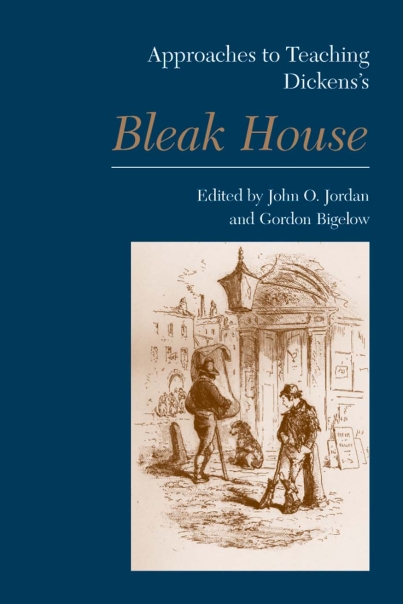

“This splendid volume of essays does more to highlight Dickens’s dazzling achievement in Bleak House than any critical intervention I have encountered. I found practices that will translate into my own teaching regardless of differences in context.”
—Carolyn Dever, Vanderbilt University
“Offers a wide range of creative, practical, and inviting strategies for teaching Dickens’s behemoth.”
—Dickens Quarterly
A central text both in Dickens’s career and in the history of the novel itself, Bleak House provides students and teachers occasion to discuss Victorian social concerns involving law, crime, family, education, and money and to learn about every stratum of English society, from the aristocracy to the homeless. But the sheer size of the novel and its narrative intricacy pose pedagogical obstacles. The essays in this volume offer instructors an array of practical strategies for use in the classroom: some describe courses organized exclusively around Bleak House; others offer ideas for teaching a single scene or topic in the novel.
Part 1, “Materials,” assesses editions and provides a guide to the wealth of resources available to instructors, including reference works, critical studies, and background readings, in print and on the Web. The essays in part 2, “Approaches,” discuss nineteenth-century British culture and Victorian social texts; present ways to teach specific scenes, patterns, and problems in the novel; describe intertextual approaches; and detail specific courses taught in different settings and at a variety of educational levels.
Joel J. Brattin
Kathleen Breen
Timothy Carens
Janice Carlisle
Carrol Clarkson
Denise Fulbrook
Michal Peled Ginsburg
Lauren M. E. Goodlad
Robert Googins
Daniel Hack
Nita Moots Kincaid
Shu-Fang Lai
Barbara Leckie
Kevin McLaughlin
Robert Newsom
Robert L. Patten
Timothy Peltason
Jennifer Phegley
Hilary Schor
Richard L. Stein
Lisa Sternlieb
Robert Tracy
Andrew Williams
Preface to the Series (ix)
Introduction (1)
Illustrations (5)
PART ONE: MATERIALS
Editions (17)
Bibliographies (17)
Reference Works and Other Resources (18)
Visual, Audiovisual, and Electronic Materials (19)
Readings for Students (22)
Contextual Reading (22)
Critical Essays (22)
Theoretical Essays (23)
Readings for Teachers (24)
Biographies (24)
Critical Perspectives (24)
PART TWO: APPROACHES
Victorian Contexts
The Crystal Palace and Dickens’s “Dark Exhibition” (31)
Bleak House, Africa, and the Condition of England (38)
Bleak House and the Culture of Advertising (45)
Bleak House and the Culture of Commodities (51)
Bleak House, Paper, and Victorian Print (57)
Bleak House and Victorian Science (64)
Teaching Specific Scenes, Patterns, or Problems
The Esther Problem (71)
What Esther Knew (79)
Mr. Tulkinghorn’s Chambers (85)
Plot and the Plot of Bleak House (92)
The Reader as Detective: Investigating Bleak House in Class (99)
Bleak House and Illustration: Learning to Look (106)
Intertextual Approaches
Teaching Bleak House and Victorian Prose (113)
Bleak House and Uncle Tom’s Cabin: Teaching Victorian Fiction in a Transatlantic Context (120)
Transatlantic Transformation: Teaching Bleak House and The Bondwoman’s Narrative (126)
Bleak House and Neoliberalism (132)
Teaching Bleak House in a Comparative Literature Course: Dickens, Hugo, and the Social Question (142)
Fever and AIDS: Teaching Bleak House in South Africa (149)
Specific Teaching Contexts
Teaching Bleak House in Advanced Placement English (157)
Teaching Bleak House and Nothing but Bleak House (164)
Bleak House in Law School (171)
Curating Bleak House (179)
Teaching Bleak House in Serial Installments (185)
Bleak House and Narrative Theory (191)
Appendixes
A Bleak House Chronology (199)
“Borroboola Gha: A Poem for the Times” (201)
Notes on Contributors (205)
Survey Participants (209)
Works Cited (211)
Index of Names (227)
