Approaches to Teaching Blake’s Songs of Innocence and of Experience
- Editors: Robert F. Gleckner, Mark L. Greenberg
- Pages: xvi & 162 pp.
- Published: 1989
- ISBN: 9780873525176 (Hardcover)
- ISBN: 9780873525183 (Paperback)
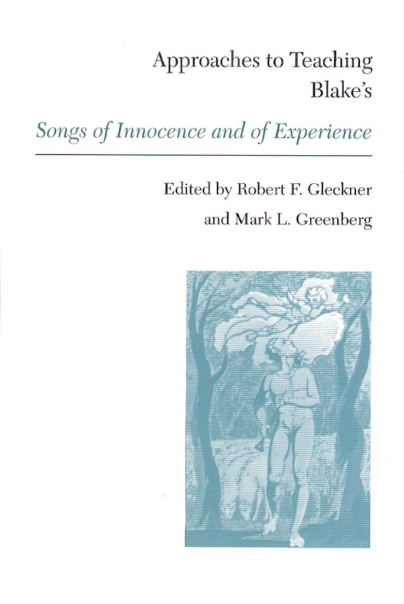

“Most valuable about the collection is the editors’ insistence on treating Blake’s poems in their illuminated format, and hence on including essays that probe ways in which students may be moved toward fuller appreciation of both the verbal and the visual aspects of Blake’s illuminated pages.”
—The Eighteenth Century
Responses to a survey conducted for this volume indicate that most teachers of Blake begin with Songs of Innocence and of Experience; the work is included in the syllabi of courses on literature and poetry at all levels, as well as courses in religious studies, humanities, and composition. The book’s continuing fascination can be attributed to the many intellectual, theoretical, and pedagogical challenges it presents for students and teachers alike, such as the particulars of Blake’s language and punctuation, his use of illustrations, differences in the order of the poems among the various extant editions, and considerations of what—for Blake and for other poets—constitutes “writing” and “the book.”
This Approaches volume, like other volumes in the MLA’s Approaches to Teaching World Literature series, is divided into two parts. The first part, “Materials,” reviews editions and anthologies, critical works (including a survey of available commentaries on each poem), background materials, and facsimile and microfiche reproductions. In the second part, “Approaches,” distinguished teachers and scholars describe strategies for presenting the Songs in the classroom. The first four essays discuss how teachers can bring theoretical concerns, such as textual and feminist approaches, to bear on specific poems. The following four essays address the inclusion of Songs in particular classes, from a survey on English Romanticism to a literature course at a technological institute. The third set of essays examines the Songs from specific literary perspectives, such as an analysis of the variations among different editions and an investigation of the work’s biblical foundations. The final four essays present approaches for teaching individual poems.
“Amongst these riches then, there should be something for everyone who teaches Blake’s lyric poetry, especially if readers are willing to share the editors’ ‘delight in imagining fruitful class discussions emanating from significant disagreements with approaches offered here.’”
—Blake: An Illustrated Quarterly
